Your Senior Journey
Your Senior Journey
Balance Training for Anxiety: How 5-Minute Daily Movements Reset Your Nervous System
Disclaimer: This post may contain affiliate links; I may earn a commission at no extra cost to you.
You have just put the phone down after a worrying conversation with a family member, and that familiar, tight knot begins to coil in your stomach.
Perhaps you’ve opened a bill that is far higher than you expected, or you are staring at the calendar, dreading tomorrow’s dentist appointment because you know the news won't be good.
In these moments, your mind feels like a runaway train. The thoughts loop and the worry grows until you feel lost and unsteady in your own home.
With your mind racing automatically, this cycle of anxiety makes it impossible to focus on anything else. You find yourself trapped in a loop of questions that seems to have no end.
This article reveals the hidden science behind why anxiety makes you stumble and gives you the simple exercises needed to combat it. Discover how to use these 5-minute moves to reset your nervous system and regain your physical and emotional steady ground.
The "Stuck" Brain
When we are caught in these cycles of midlife anxiety, we often try to "think" our way out of it. We tell ourselves to calm down, or we sit perfectly still, hoping the feeling will pass. Usually, this just gives the anxiety more room to grow.
Your mind feels like a house full of people all talking over one another at the same time. If you do not find a way to clear the room, the constant chatter begins to wear you down physically. This endless background noise of worry eventually affects your sleep and your physical health.
You need a simple way to quiet the crowd so you can finally find some peace.
The Instant Solution: Challenge Your Stability
The fastest way to shut down the "mental noise" in your head isn't by sitting still. It is by challenging your physical balance to force your brain to hit the reset button.
To understand why this works so quickly, we have to look at the "Internal GPS" of your body. This system is known as Proprioception, and it is the secret to moving from panic to peace.
The Science of "Proprioception": Your Brain’s Internal GPS
You might not have heard the word proprioception often, but you use it every single second. It is your brain’s ability to sense exactly where your body is in space without you having to look at your limbs.
When you are anxious, your "Internal GPS" is stuck on a future that hasn't happened yet (those "what if" thoughts). By performing a balance exercise, you force that GPS to immediately recalibrate to the "Now."
Scientific Fact: Your "internal GPS" is processed in a part of the brain called the cerebellum. There is a fascinating scientific reason why this part of your brain is the secret to finding your calm.
The cerebellum is not just responsible for keeping you steady on your feet. It is also deeply connected to the areas of your brain that manage your emotions and stress levels.
Recent studies, including those from the University of Cambridge, show that menopause can actually change the regions of the brain that handle these feelings. This is why you might feel more overwhelmed or physically "off-balance" than usual.
The Balanced Mind Cycle
This diagram explains the "Override Switch". It shows the direct connection between feeling anxious and feeling "wobbly," and how this can be fixed with simple physical action.
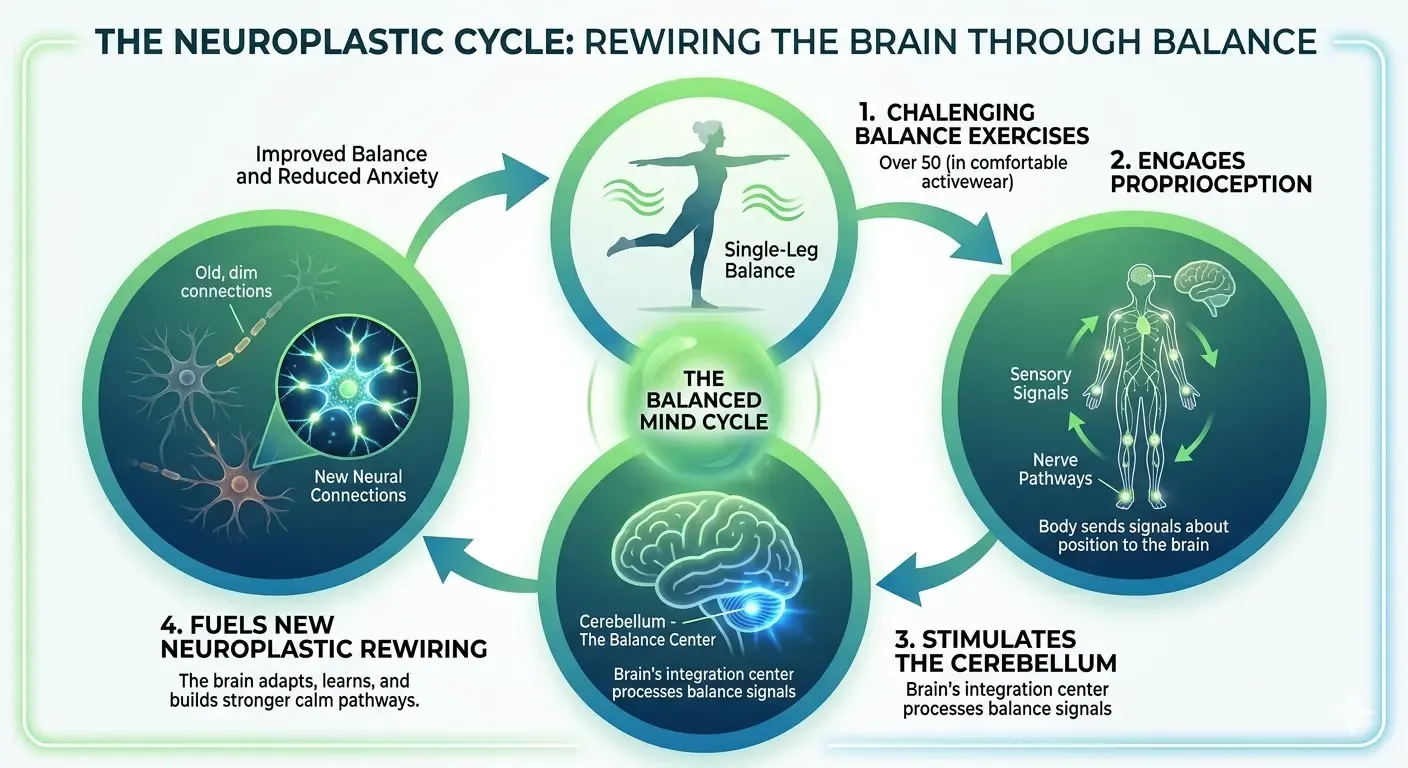
1. The Challenge: Menopause often creates a thick brain fog that leads to racing thoughts and constant worry.
2. Confused Signals: Your proprioception (your internal GPS) gets confused by this mental clutter, which is why you might feel clumsy or unsteady on your feet.
3. The Intervention: Simple balance moves force your brain to clear the fog so it can prioritise staying upright.
4. The Result: Neuroplasticity is the "rewiring" that happens every time you practice, leading to long-term calm and stronger neural pathways.
Why Your Brain Prioritises Balance Over Worry
This is where the magic happens. In your brain, there is a constant battle for resources between the Amygdala (the fear centre) and the Cerebellum (the balance and coordination centre).
When your brain detects a threat like anxiety, it shifts all its energy to the fear centre to help you survive that perceived danger. Because it is so focused on the "threat," it has less energy left for the cerebellum to manage your balance, which is why you feel so wobbly.
Avoiding a fall is a much higher priority for your nervous system than worrying about the future.
The moment you stand on one leg, your brain is forced to "mute" the Amygdala so it can use that energy to keep you upright. It is a physical "Override Switch" for your anxiety.
The short video below explains exactly why feeling anxious makes you more likely to feel unsteady. It is a powerful look at how your emotions physically change how you move and why you need to hit the "reset" button.
3 Simple Balance Drills for Instant Emotional Release
You don’t need a gym or fancy equipment to do this. These drills are designed to be done in your kitchen, your hallway, or even while you wait for the kettle to boil.
1. The Stork Stand (Beginner)
Stand near a kitchen counter for safety. Lift one foot just an inch off the ground and try to hold it for 30 seconds.
The Secret: If your mind starts to wander back to your worries, you will wobble. This wobble is the "reset" happening in real-time.
2. The Tightrope Walk (Intermediate)
Find a line on a rug or a floorboard. Walk ten steps forward, placing the heel of one foot directly in front of the toes of the other.
The Secret: This forces your eyes and your inner ear to work together, leaving no "bandwidth" left for anxious thoughts.
3. The Sensory Shift (Advanced)
Stand with your feet together and your hands by your sides. Once you feel stable, simply close your eyes.
The Secret: By removing your sight, you force your brain to rely 100% on proprioception. You will feel your ankles making tiny adjustments - this is your nervous system grounding you in the present moment.
Pro-Tip: If you feel a surge of panic coming on, try the "Stork Stand" immediately. It is much harder to have a panic attack while your brain is busy trying to figure out how to stay on one leg!
If you found these drills helpful, please do click the subscribe button below. I have an upcoming guide on new techniques to calm your mind, and you will be amazed at how quickly they work to settle your nerves.
Moving with Joy: Stability is Emotional Safety
At Your Senior Journey, I talk about "Moving with Joy" because exercise should never be a chore. When you practice these balance drills, you aren't just preventing falls; you are building a foundation of emotional safety.
When your body feels stable and strong, your subconscious mind begins to believe that you are stable and strong. This physical confidence bleeds into your emotional life.
You start to realise that if you can handle the "wobble" on the floor, you can handle the "wobble" of a stressful phone call. For more ways to find your centre, explore my Instant Calm Series or learn about the deep connection between your body and your nerves in my guide to the Vagus Nerve.
DEEP DIVE: Level Up Your Mind-Body Connection

If you are ready to go beyond simple drills and truly rewire your brain for a lifetime of clarity, I highly recommend looking into the Mindvalley curriculum.
For my readers, I suggest exploring "Calm Mind" by Dr. Caroline Leaf. It is a scientific, 7-day journey that fits perfectly with the neuroplasticity we’ve discussed today.
Full Disclosure: I am a proud affiliate for Mindvalley. This means if you decide to join a course through my link, I may earn a commission at no extra cost to you. I only recommend programs that I truly believe will support your journey toward emotional well-being.
For further reading on the fascinating link between balance training and anxiety reduction, check out this study on the neuroscience of exercise and how it rebalances the brain's emotional circuits.
Stay Updated - Sign Up for My Newsletter
Stay informed with expert advice for women over 50, right in your inbox. Join me!
Latest Articles:
Your Senior Journey - Supporting women over 50 through life's changes with confidence and healthy living.
© 2026 - yourseniorjourney.com - all rights reserved.