Your Senior Journey
Your Senior Journey
Food Freedom: Break the Emotional Eating Cycle After 50 - Module 1
Disclaimer: This post may contain affiliate links; I may earn a commission at no extra cost to you.
Welcome to the free introductory module of "Food Freedom: Break the Emotional Eating Cycle After 50.
This training is best viewed on a computer or laptop. This ensures you can use the interactive worksheets comfortably while you work through the steps.
This introductory module is designed to help you release food guilt and feel more peaceful around eating. It provides the essential foundation you need to start shifting your habits straight away.
Breaking free from emotional eating is a vital step in reclaiming your wellness at this stage of life. If you are truly ready to make a change, there are two distinct paths available to you:
1. The Premium Path: A comprehensive course by Eric Edmeades, which helped me personally achieve lasting changes in my relationship with food.
2. The Core Training: This free introductory module gives you immediate tools to start, while my full Emotional Wellness & Food Bundle (Modules 2–5) provides the complete roadmap for just $9.29.
Please do not underestimate what this first module can do for you. Reading the words alone isn’t enough; to see real change, you must put these small shifts into practice.
I have included a bonus for you inside this module: a free downloadable worksheet to make these steps easier to implement. At the end of this page, you will find details on how to unlock the complete 5-module system to fully break the cycle of food shame.
Here’s what’s ahead:
Module 1 – Awareness
(This one!) Understand your emotional eating patterns and what triggers them.
Module 2 – Mindset Shift
Learn Kind Self-Talk and Build Self-Trust Around Food (+ Free Eating Tracker Included!)
Module 3 – Mind-Body Skills
Connect body and mind with mindful snacking, meditation, and deep breathing.
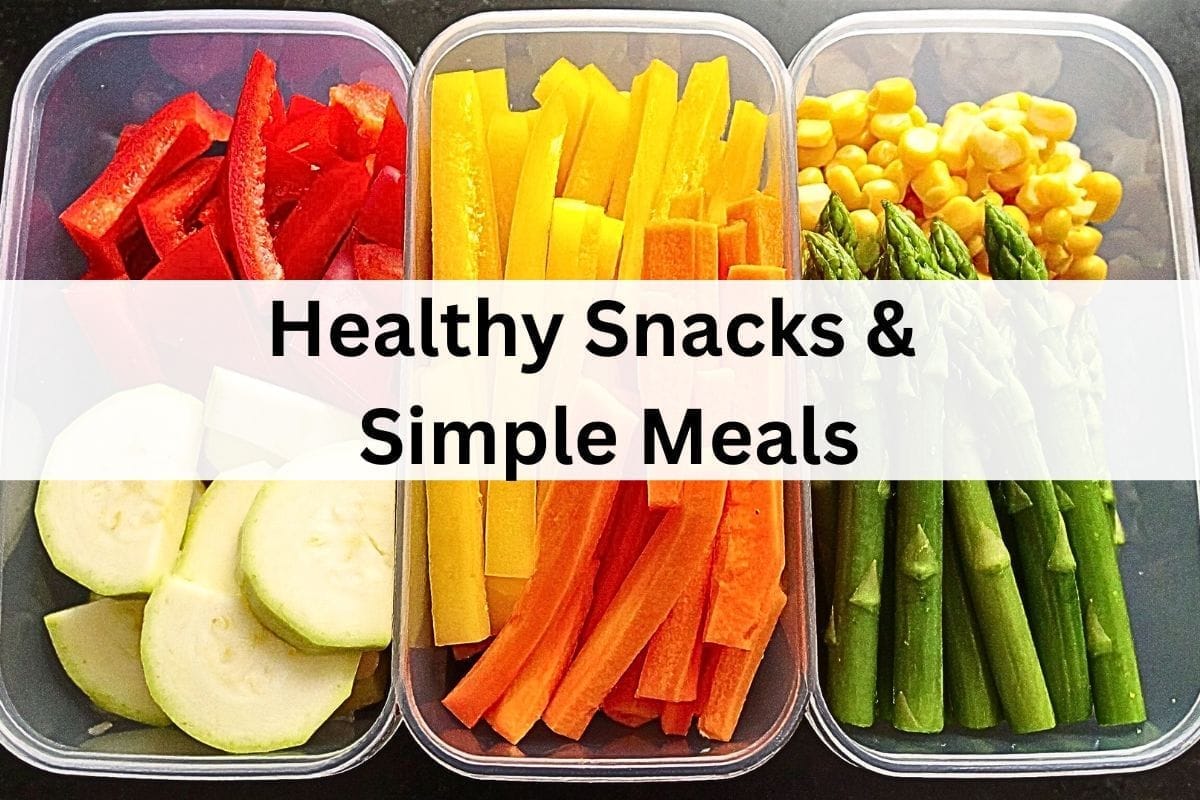
Module 4 – Practical Eating Habits
Discover meals that keep you full, energised, and in control - with a handy mobile-friendly guide for snacks and simple meals.
Module 5 – Confident Eating in Any Situation
Handle social outings with ease, feel freedom around your food choices, and explore mindful, guilt-free experiments.
MODULE 1
RECOGNISING EMOTIONAL EATING PATTERNS
In Module 1, we’ll explore why emotional eating happens, how to recognise your personal triggers, and what’s actually going on in your body when you reach for that “comfort” snack.
In my opinion, this is where confidence begins - not through restriction, but through understanding and compassion toward yourself.
EMOTIONAL EATING AFTER 50:
UNDERSTANDING THE HABIT, NOT THE GUILT
Why do you reach for food when you’re not hungry?
Emotional eating isn’t a flaw. It’s a learned habit - one your mind and body picked up as a way to soothe, comfort, distract, or momentarily lift your mood.
Maybe it’s chocolate after a stressful phone call…
A packet of crisps when boredom hits…
A biscuit because “it’s been a day.”
You’re far from alone.
Research shows emotional eating is common among women in midlife, especially during times of stress, loneliness, or hormonal changes.
The key first step is noticing your own patterns. Pay attention to the moments, emotions, or triggers that lead you to eat when you’re not physically hungry. This habit often comes from past experiences and learned coping mechanisms, and simply recognising it is the foundation for change.
The goal here is not to judge yourself - it’s to finally understand the pattern.
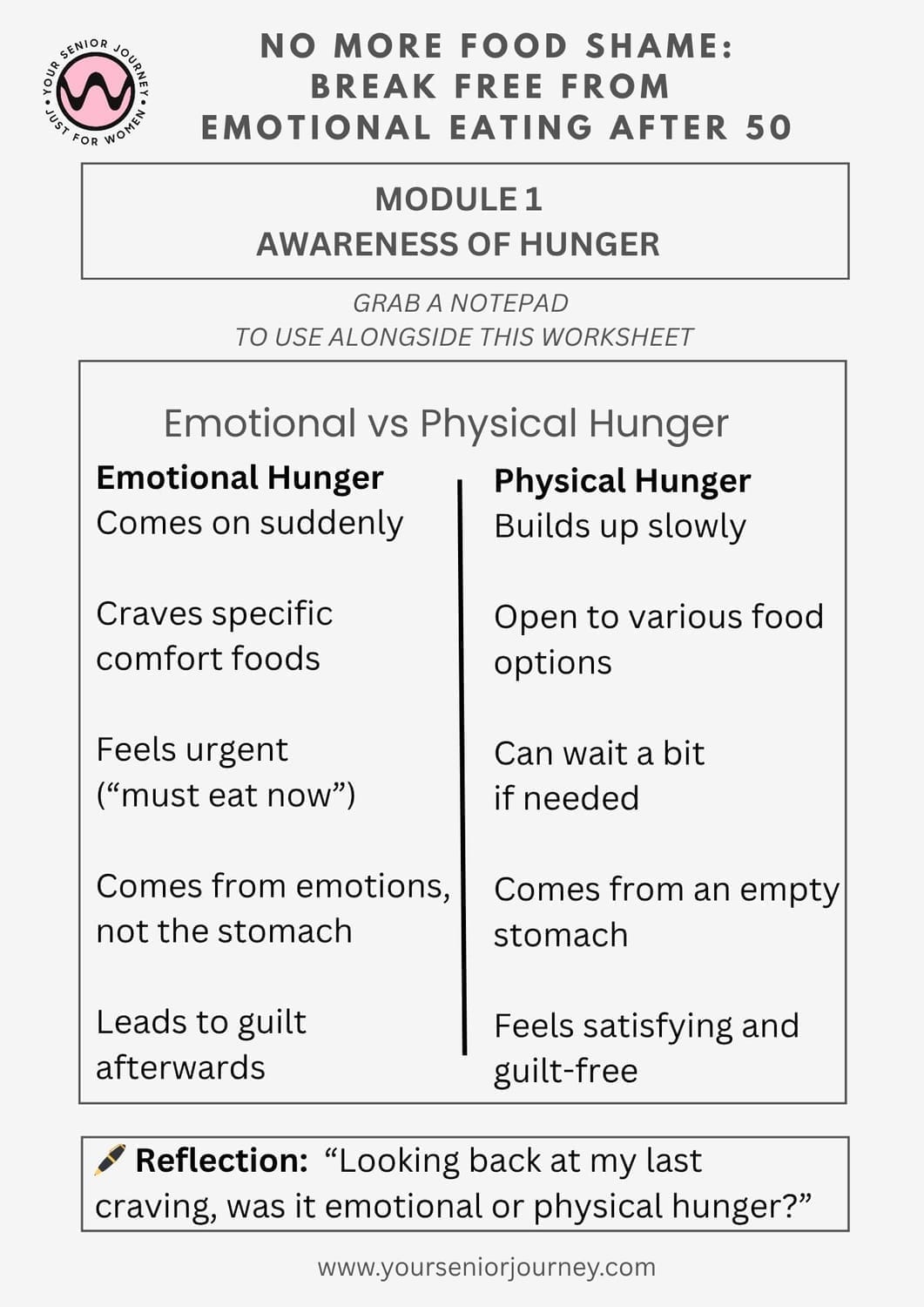
Emotional vs. Physical Hunger — A Quick Guide
A quick guide to tell the difference:
Emotional Hunger
Comes on suddenly
Craves specific comfort foods
Feels urgent or “must eat now”
Comes from emotions: stressed, bored, sad, happy
Leads to guilt afterwards
Physical Hunger
Builds up slowly
Open to various food options
Can wait a bit if needed
Comes from an empty or rumbling stomach
Feels satisfying and guilt-free
Ask yourself:
👉 “Am I physically hungry - or am I feeling something else?”
This tiny pause builds self-awareness fast.
WHAT'S REALLY BEHIND YOUR CRAVINGS
(THE BRAIN-BODY CONNECTION)
There’s a real reason comfort foods feel comforting - and it has nothing to do with “weak willpower.” Your brain is wired to seek quick rewards, and foods high in sugar or refined carbs deliver a fast burst of dopamine, your brain’s natural “feel-good” chemical.
When you eat something sweet or indulgent, dopamine spikes. You feel calmer, soothed, or just a little better. It works - but only for a moment.
Then comes the crash:
Feeling tired or sluggish
Brain fog or difficulty concentrating
Heightened irritability or mood swings
Craving more of the same foods
This cycle of quick highs and crashes is exactly why emotional eating can feel so hard to resist - your brain remembers the reward and keeps asking for it.
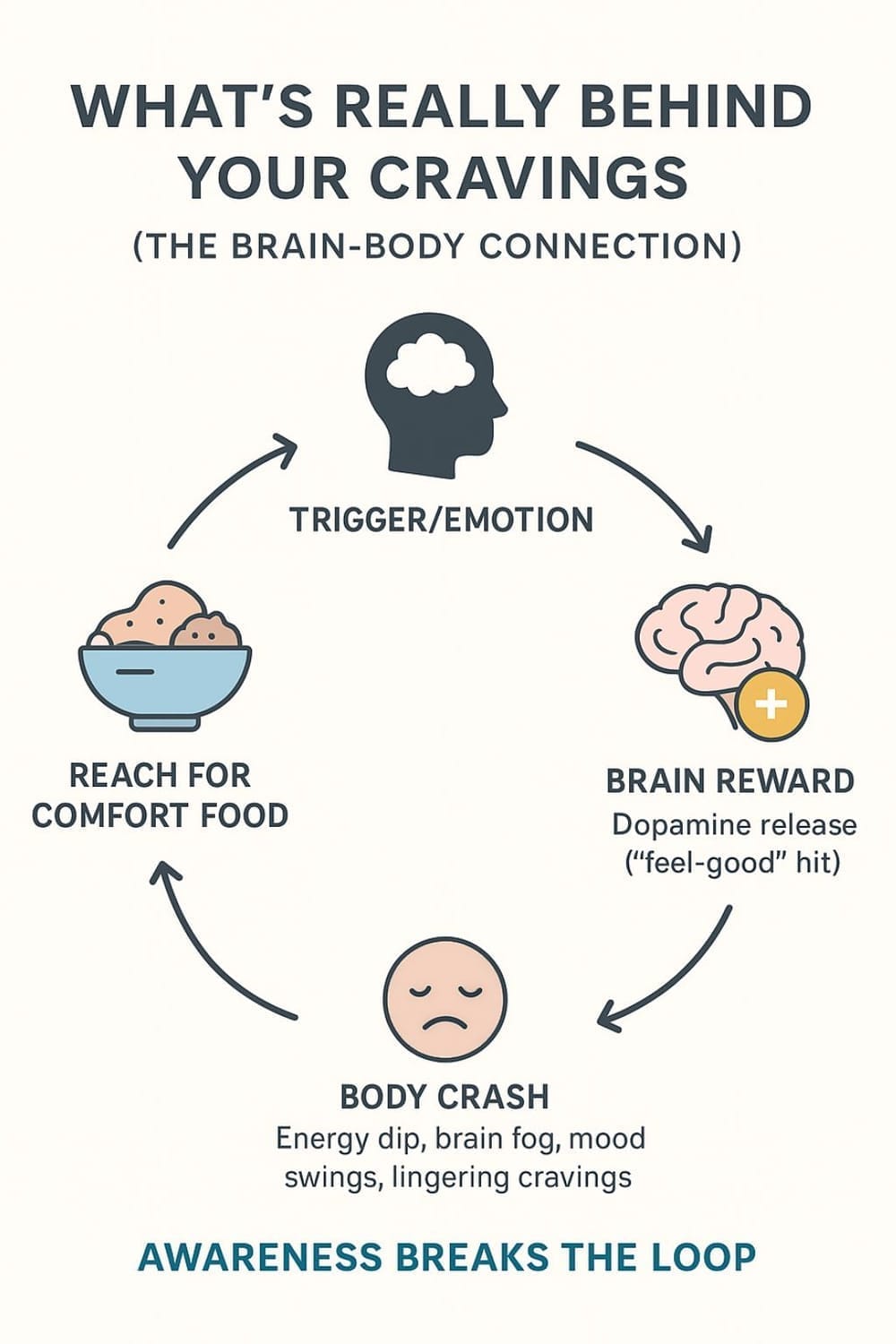
But here’s the empowering part: once you understand why the craving shows up, you stop seeing it as a personal flaw. You start recognising it as a predictable brain-body response - one you can gently interrupt.
Awareness gives you the upper hand. Instead of fighting cravings with guilt, you learn to respond with clarity. And when you do that consistently, cravings gradually lose their hold, and you begin choosing rewards that truly support your body and your emotional wellbeing.
WHERE IT ALL BEGAN-
CHILDHOOD REWARDS AND LEARNED BEHAVIOURS
Emotional eating rarely starts in adulthood. Most of us learned these patterns early - often in caring homes where no one realised the long-term impact.
Think back:
You fell down and cried - someone gave you a biscuit to cheer you up.
You were upset - a snack helped you calm down.
You celebrated birthdays or holidays - food was love and joy.
Without noticing, we learned:
Food = comfort
Food = reward
Food = love
Advertising and Media Influence
Modern marketing strengthens this emotional connection even further. Advertisers intentionally link food with feelings most of us crave: happiness, confidence, belonging, success, family closeness.
A chocolate bar becomes a “treat you deserve.”
Crisps become part of a fun evening.
Ice cream becomes the answer to a difficult day.
And here’s something important:
Mature adults are a prime target.
Brands know that women over 50 often juggle stress, caregiving roles, hormonal changes, and emotional load - all of which can make comfort-food messaging even more persuasive. When you’re tired or overwhelmed, your brain is naturally more responsive to these cues.
Once you see how these tactics work (colour psychology, emotional storytelling, nostalgia, repetition), you stop reacting automatically.
That tiny moment of awareness gives you space to choose what you truly want - not what a marketing campaign nudges you toward.
A SIMPLE HACK TO PAUSE CRAVINGS (10-MINUTE RESET)
Here’s one of my favourite tools - simple but incredibly effective:
When the craving hits: wait 10 minutes and drink a glass of water.
During these 10 minutes you:
Give your emotions space to settle.
Allow your brain to catch up with your body.
Often realise the craving passes or softens.
Then ask yourself:
👉 “Do I still want this - or was I just looking for comfort?”

And if you still choose the snack?
You’ll eat it consciously - not on autopilot. That’s progress.
SPOT YOUR TRIGGERS - WEEKLY TRACKING EXERCISE
(This is your ONE core exercise for Module 1.)
All you need is a notebook.
Each time you snack when not hungry, write:
1️⃣ Time of day
2️⃣ What was I feeling?
3️⃣ What triggered this urge?
4️⃣ How did I feel while eating?
5️⃣ How did I feel afterwards?
At the end of the week, look for patterns:
Certain emotions
Certain times
Certain situations

This exercise builds the strongest awareness muscle you’ll ever develop for food freedom. - and you’ll get the free worksheet below to guide you step by step.
A Gentle Trauma Note
Sometimes emotional eating is tied to deeper pain. If journaling brings up heavy emotions, that’s a sign you may benefit from speaking with someone trained to support you.
Support Resources:
UK: Beat Eating Disorders – 0808 801 0677
USA: ANAD – 1 888-375-7767
You’re doing important work, and recognising when you need help is a sign of strength.
_____
Module 1 is your foundation - awareness sets you up for mindset, skills, habits, and ultimately freedom with food. To make it even easier to put these steps into practice, it’s time to download your worksheet and get started.
DOWNLOAD YOUR MODULE 1 WORKSHEET
Your worksheet makes everything in Module 1 simple and actionable.
It includes:
Awareness of Hunger
Pause Hack
Spot Your Trigger Prompts to Reflect
You have done beautifully working through Module 1. Awareness is a powerful first step, and it truly sets your entire transformation in motion. If you are ready to keep this momentum going, I have made the next steps very simple. You now have the foundation, but the real change happens when you apply the full system.
HOW TO UNLOCK THE CORE TRAINING
You have completed the first step in Module 1 - truly well done. To help you maintain this momentum, I have unlocked a special resource for you.
YOUR MEMBER BONUS: "The 5 Best Ways to Calm Your Mind Instantly: My Personal Toolkit for Women 50+".
These are my personal nervous system tools for women 50+. They are simple, proven techniques designed to stop "stress situations" quickly and provide fast relief so you can move through your day with calm and peace.
What you will find inside when you continue:
The Calm Rituals (Free): 5-minute practical steps to stop a racing mind and reclaim your stillness. These are sent straight to your inbox.
The Wellness & Core Training Bundle ($9.29): This includes Modules 2–5. It is a complete system to help you break the cycle of food shame and midnight kitchen raids.
Staying where you are means continuing the cycle of food shame and midnight kitchen raids. This exhaustion doesn't just affect your weight; it drains the energy you need for your family and your own joy.
Stop the cycle today
Staying where you are means continuing the struggle with exhaustion that drains the energy you need for your family and your own joy. One module is a fantastic start, but without a plan to settle your mind, it is easy to slip back into old habits when stress peaks.


5 Rituals for Instant Calm:Your Pocket Guide
Stop the Racing Mind
If your head is spinning with family demands, these 5-minute rituals help you find your steady ground.
Catch Your Breath
How to stop feeling like you're constantly "on call" and reclaim a moment of stillness for yourself.
Simple & Grounded
No complicated techniques -just practical, focused steps to help you feel like you again.
You can claim your free rituals and explore the full wellness bundle right now. Simply click that button, confirm your email, and discover how to reclaim your peace.

Other Resources You Might Like
Weight Control With Kindness
Smart strategies for managing habits, hormones, and cravings - gently and sustainably.
CLICK HERE TO READ RELEVANT ARTICLES
WildFit with Eric Edmeades
This is a premium program available through Your Senior Journey Premium Courses & Programs, designed to help you reset your relationship with food and boost your energy. CLICK HERE TO FIND OUT MORE
(This is an affiliate link, so I may earn a commission if you enrol - at no extra cost to you.)
Stay Updated - Sign Up for My Newsletter
Stay informed with expert advice for women over 50, right in your inbox. Join me!
Latest Articles:
Your Senior Journey - Supporting women over 50 through life's changes with confidence and healthy living.
© 2026 - yourseniorjourney.com - all rights reserved.